Don’t Throw Away That Paperwork: Your Future Self Might Thank You
This week I’ve been working on a couple of Capital Gains Tax (CGT) cases, and both have highlighted the same lesson:
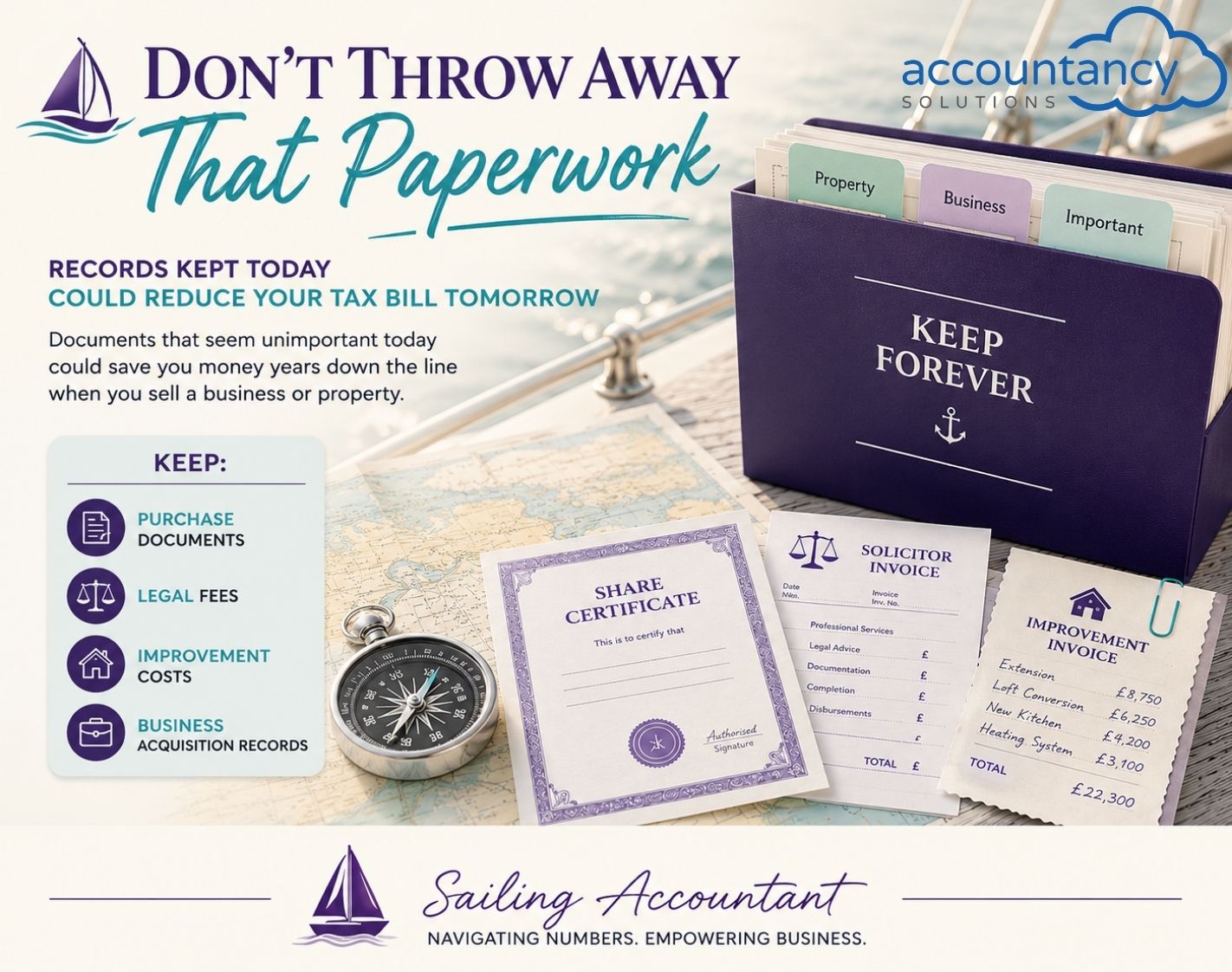
Keep your paperwork. Keep all of it.
When you’re buying a business or a property, tax is often the last thing on your mind. You’re focused on the purchase, the move, the renovations, or getting the business up and running.
Fast forward ten, twenty, or even thirty years and those old documents can make a significant difference to your tax bill.
Why does it matter?
When you eventually sell a business or property, HMRC allows certain costs to be deducted when calculating your gain.
The problem is proving those costs years later if the paperwork has disappeared.
I’ve seen many cases where clients know they spent money on improvements or professional fees, but without supporting documentation it can be difficult to include those costs in a tax calculation.
If you own a property
Even if a property is your home today, circumstances can change.
You might:
- Move away for work
- Downsize
- Keep the property and rent it out
- Inherit another property
- Move in with a partner
Years later, when the property is sold, records of qualifying improvements could help reduce your Capital Gains Tax bill.
Examples of improvements that may be relevant include:
- Extensions
- Conservatories
- Loft conversions
- Garage conversions
- New kitchens where part of a larger renovation project
- Structural alterations
- Installation of central heating where none existed before
Routine repairs and maintenance are usually treated differently, so it’s important to keep records of everything and seek advice when needed.
If you own a business
The same principle applies.
Keep records of:
- Purchase agreements
- Share purchase agreements
- Business transfer agreements
- Goodwill valuations
- Legal fees
- Professional fees
- Loan agreements
- Share certificates
- Incorporation documents
These documents can become incredibly important when the business is sold many years later.
My simple rule
Create a digital folder called:
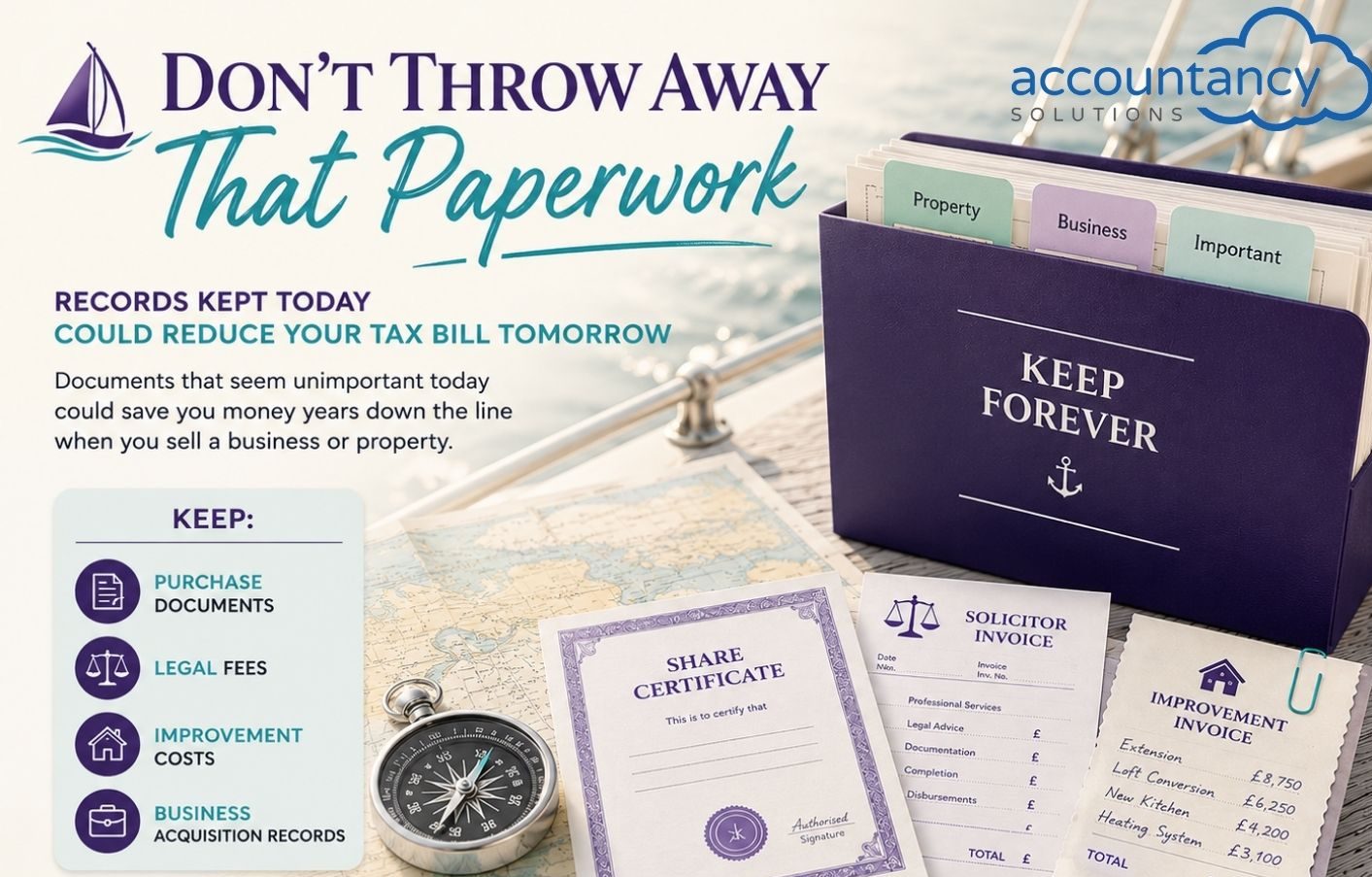
“Keep Forever”
Store copies of:
- Purchase contracts
- Completion statements
- Legal invoices
- Improvement invoices
- Valuations
- Business acquisition documents
Cloud storage is cheap.
Trying to recreate paperwork from fifteen years ago is not.
A sailing lesson
When you’re sailing, you don’t wait until you’re in rough weather to start looking for your charts.
The same applies to tax records.
Good record keeping may seem unimportant today, but when the time comes to sell a property or a business, those documents can help you navigate the journey more smoothly and potentially save a considerable amount of tax.
Your future self will be glad you kept them.