
At Accountancy Solutions, we work with small businesses, sole traders and limited companies across Portchester, Hampshire and beyond. We don’t just want to know what your numbers were last year. We want to understand your business, where you want to take it and what you need to do to get there.
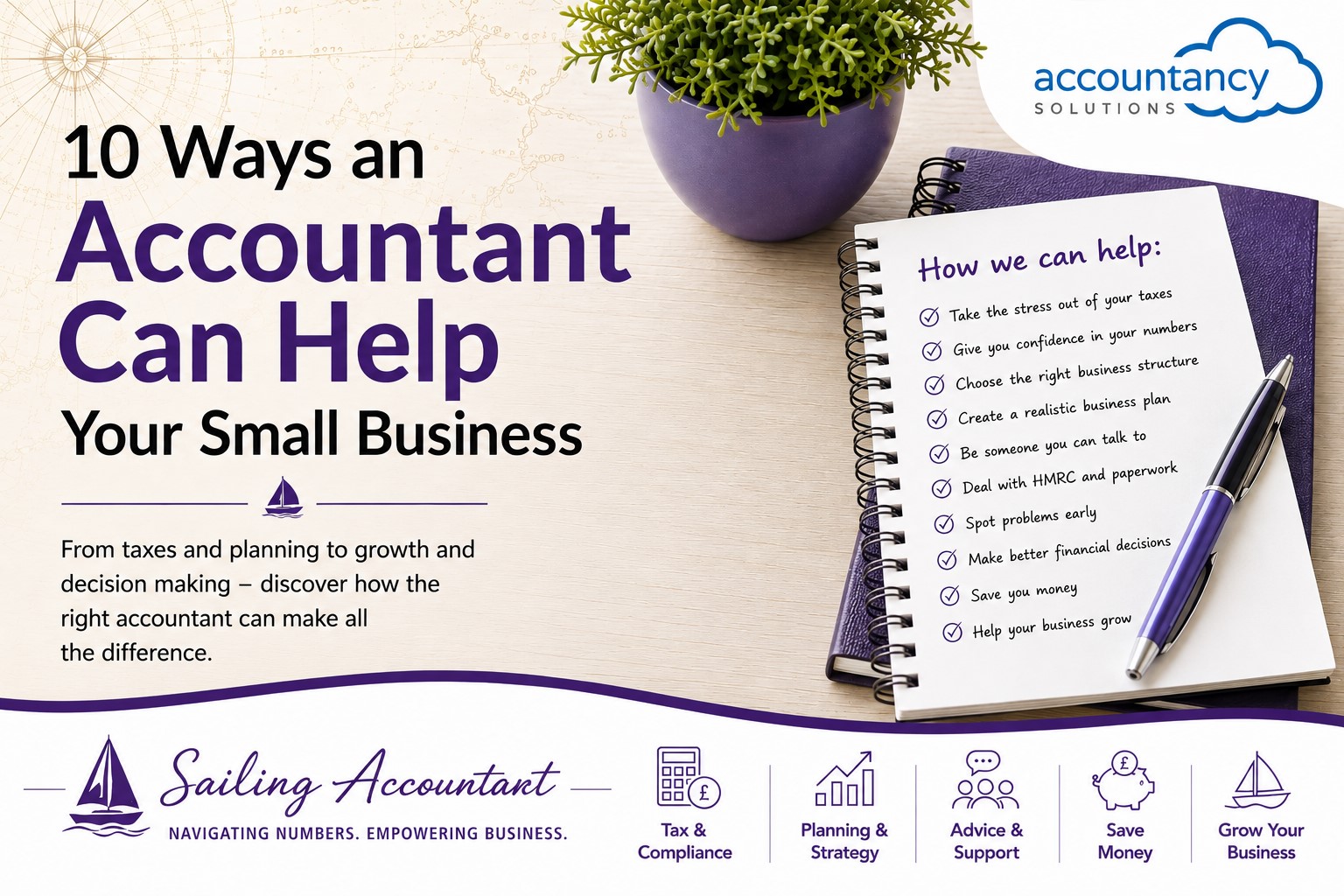
Here are 10 ways an accountant can help your business.
1. Take the stress out of your taxes
Tax can be complicated. There are different taxes, different rules, different deadlines and, of course, HMRC regulations that seem to change constantly.
Depending on your business, you may need to deal with Income Tax, Corporation Tax, VAT, PAYE, National Insurance or Making Tax Digital requirements.
Your accountant can help you understand which rules apply to you, what you need to pay and when you need to pay it.
More importantly, they can help you plan for your tax bills rather than discovering a large bill is due when you haven’t put the money aside.
For sole traders and partnerships, your accounts feed directly into your Self Assessment tax return, so getting the figures right is important. You can find out more about our Sole Trader & Partnership Accounts service.
2. Give you confidence in your numbers
Doing your own bookkeeping can seem like a good way to save money when you’re starting out.
But your time has a value too.
Spending evenings trying to reconcile your bank account, work out how to record expenses or understand your accounting software isn’t necessarily the best use of your time.
Our bookkeeping services can take that work off your hands, leaving you more time to concentrate on running and developing your business.
And having accurate, up-to-date records means you can have confidence in the numbers you’re using to make decisions.
3. Help you choose the right business structure
Should you operate as a sole trader or set up a limited company?
There isn’t one answer that works for everyone.
Your circumstances, expected profits, plans for the business and the level of risk you’re taking can all affect which structure is appropriate.
An accountant can explain the options, discuss the advantages and disadvantages and help you understand the tax and administrative implications of each.
It’s much easier to get the structure right at the beginning than to discover later that it isn’t working for you.
4. Help you create a realistic business plan
A business plan shouldn’t just be about what you hope your business will achieve.
The numbers need to support the plan.
How much do you need to sell? What will your costs be? How much do you need to pay yourself? When will you become profitable? How much cash will you need to get you through the early months?
An accountant can help you turn your ideas into realistic financial forecasts and budgets.
Once your business is up and running, management accounts can help you keep track of whether you’re actually heading in the direction your business plan predicted.
That can also be invaluable if you’re looking for finance or investment, because lenders and investors will want to see that you’ve thought carefully about the financial side of the business.
5. Be someone you can talk to
Running a business can sometimes feel like you’re making every decision on your own.
A good accountant can be a sounding board.
Want to take on your first employee? Thinking about buying a van? Considering taking on premises? Wondering whether you can afford to reduce your hours in another job and concentrate on the business?
These are exactly the sorts of conversations you should be able to have with your accountant.
We believe you shouldn’t have to wait until your year-end accounts are prepared before talking about your business.
6. Deal with HMRC and the paperwork
There is a lot of administration involved in running a business.
VAT returns, payroll, Corporation Tax returns, Self Assessment, confirmation statements, Making Tax Digital and other compliance requirements can quickly become overwhelming.
Missing a deadline can result in penalties, while getting something wrong can create unnecessary work and potentially additional tax.
An accountant can keep track of the deadlines and deal with much of the administration for you, giving you one less thing to worry about.
For limited companies, this includes preparing and submitting your annual statutory accounts and dealing with the relevant Companies House and HMRC requirements.
And if you have employees, outsourcing your payroll can take another significant administrative burden off your shoulders.
7. Help you spot problems before they become serious
One of the biggest benefits of keeping your accounts up to date is that you can see what is actually happening in your business.
Are your sales increasing but your profit isn’t?
Are your costs creeping up?
Are customers taking too long to pay?
Are you making enough money to cover your drawings or salary?
These things can be difficult to spot when you’re busy running the business.
Regular management accounts can highlight potential problems early, when there is still time to do something about them.
They can also help you monitor income, expenses, sales and margins, giving you a much clearer picture of how your business is performing.
8. Help you make better financial decisions
An accountant shouldn’t simply tell you what happened. They should help you understand what it means.
Your accounts can tell you much more than whether you’ve made a profit.
They can help you understand your margins, cash flow, overheads, customer profitability and overall financial performance.
That information can help you decide where to focus your time and money.
Sometimes the answer might be to increase prices. Sometimes it might be to reduce unnecessary costs. Sometimes it might be to invest in the business.
The important thing is making those decisions based on reliable information rather than guesswork.
9. Help you save money in the right places
An accountant isn’t there simply to reduce your tax bill at all costs.
Good tax planning is about making sure you’re using the allowances, reliefs and structures that are legitimately available to you while making sensible financial decisions for your business.
It might involve planning when you take money from your company, considering pension contributions, making the most of allowable expenses or thinking ahead about major purchases and investments.
The key is planning ahead.
By the time your accountant is preparing your accounts and tax return, many opportunities to plan may already have passed.
10. Help your business grow
Ultimately, an accountant should be interested in more than getting your accounts submitted.
They should understand where your business is now and where you want it to be.
As your business grows, your needs change. You might employ your first member of staff, become VAT registered, move from sole trader to limited company, take on premises, invest in equipment or start looking at expansion.
Having an accountant who understands your business means you have someone alongside you as those changes happen.
Your accountant should be part of your team
Choosing an accountant isn’t just about finding the cheapest price for your annual accounts.
It’s about finding someone you trust with some of the most important information about your business.
At Accountancy Solution, we’re a small, friendly accountancy practice based in Portchester, Hampshire. We work with small businesses and entrepreneurs who want more than someone who simply prepares their accounts once a year.
From bookkeeping and annual accounts to payroll, VAT, Self Assessment, Corporation Tax, company secretarial services and business advice, we provide practical support designed to help you stay on top of your finances and make informed decisions.
You can see our full range of accountancy and business services on our website.
Because your accountant should do more than tell you what happened last year.
They should help you understand where your business is going next.
If you’re looking for an accountant in Portchester, Fareham, Portsmouth, Hampshire or further afield, we’d love to have a chat about your business and how we could help.
Get in touch with Accountancy Solutions today to arrange a free, no-obligation consultation.
Sign up to our mailing list to get news and blog posts straight to your inbox.
Accountancy Solutions is an accountancy practice based in Portchester, Hampshire, providing bookkeeping, accounts, tax and business advisory services to small businesses across Portsmouth, Fareham, Gosport, Havant, Waterlooville and the surrounding area.
© Accountancy Solutions Ltd | Portchester, Hampshire