You can’t just take money out because you intend to put it back
The case, McCarthy v Marshall [2026] EWHC 1585 (Ch), involved a director who had used company money to pay for personal expenditure over a number of years.
The money was recorded through a director’s loan account, and the director argued that he had always intended to repay it and that his fellow shareholder knew about the arrangement.
The Court did not accept this.
It found that the personal use of company money had not been properly authorised and amounted to a breach of the director’s duties.
Importantly, the fact that the director intended to repay the money did not make the original transactions acceptable.
In other words, “I’ll put it back later” is not the same thing as having permission to take it in the first place.
What exactly is a director’s loan account?
A director’s loan account, or DLA, is simply a record of money moving between you and your company that isn’t salary, dividends, reimbursement of a genuine business expense or money you have previously put into the company.
For example, your DLA might show:
- You put £10,000 of your own money into the company. The company owes you £10,000.
- You take £2,000 from the company that isn’t salary or a dividend. You owe the company £2,000.
- You pay a genuine company expense personally. The company may owe you that money.
- You repay money you previously borrowed from the company. Your loan balance reduces.
HMRC expects companies to keep proper records of these transactions, and the balance on the director’s loan account needs to be reflected in the company’s accounts.
A DLA itself isn’t a problem. The problem is using it as an informal personal bank account without the appropriate authority, records and tax treatment.
“But I’m the owner, so surely I can take the money?”
This is one of the most common misunderstandings we see with owner-managed companies.
Being a shareholder does not mean you can simply take money from the company’s bank account whenever you want.
There are different ways of taking money from a limited company, including:
- salary
- dividends
- reimbursement of genuine business expenses
- repayment of money you have previously loaned to the company
- a properly documented director’s loan
Each has different rules and, in some cases, different tax consequences.
The important thing is that the transaction is correctly identified and recorded.
If you take £5,000 from the company to pay for a personal expense, it doesn’t become a business expense simply because you own the company.
It may instead be a loan to you, and that needs to be dealt with properly.
There can be tax consequences
There is another reason not to ignore an overdrawn director’s loan account.
If you are a shareholder as well as a director, and your company is a close company, there can be a Corporation Tax charge under the rules for loans to participators.
For example, if money remains owing to the company nine months after the end of the Corporation Tax accounting period, the company may have to pay additional Corporation Tax under the section 455 rules. There are exceptions and detailed rules, so this is something your accountant should check rather than something to try to work out from a Google search.
There can also be personal tax implications where a director or employee has the benefit of a company loan, particularly where the loan is above certain thresholds or is provided at less than the official rate of interest.
And if a loan is eventually written off rather than repaid, there can be further tax consequences for both the company and the individual.
So an overdrawn DLA is not something to leave sitting in the accounts year after year hoping it will somehow disappear.
What did the High Court case say?
The circumstances of McCarthy v Marshall were more complicated than the typical small business situation, but the principle is particularly relevant to owner-managed companies.
The Court found that the director had used company funds for personal expenditure without the necessary authorisation.
The director argued that there had effectively been an informal agreement between the shareholders and that he had intended to repay the money.
The Court rejected that argument.
It also made clear that informal assumptions are not necessarily enough when it comes to company money. If a director is going to borrow money from the company, the authority for doing so needs to be properly established.
The Court’s findings in this particular case were serious, including a finding that the conduct amounted to a fraudulent breach of fiduciary duty.
That does not mean that every overdrawn director’s loan account is fraudulent.
It does, however, demonstrate why directors should not assume that an informal arrangement is acceptable simply because everyone involved is comfortable with it at the time.
What should you do if you need money from your company?
The simplest approach is to decide how the money should be taken before transferring it.
For example:
Is it salary?
Make sure it is dealt with through payroll and the appropriate PAYE and National Insurance rules.
Is it a dividend?
Make sure there are sufficient distributable profits and that the dividend is properly declared and documented.
Is it reimbursement for something you have bought for the business?
Keep the receipt and record it as a genuine business expense.
Is it money you previously put into the company?
It may be repayment of money the company owes you.
Is it a genuine loan from the company to you?
Make sure it is recorded correctly, consider whether shareholder approval is required and understand the tax implications.
That small bit of planning can save a lot of trouble later.
Don’t rely on “we’ve always done it this way”
One of the biggest lessons from this case is the danger of informal arrangements.
In a small business, it is very easy for things to develop gradually.
Perhaps you transfer £500 from the business account to your personal account and tell yourself you’ll sort it out later.
Then you do it again.
Then the company pays a personal credit card bill.
Then you put some money back.
Before long, there are dozens of transactions moving backwards and forwards and nobody is quite sure what the balance should be.
That is when your director’s loan account can become difficult to manage.
And if you have more than one director or shareholder, assumptions about what everyone has agreed can become particularly dangerous.
If something is agreed, document it. If money is borrowed, record it. If something is a dividend, declare it properly.
Good records are much easier than trying to reconstruct everything at the end of the financial year.
What if you close the company with an overdrawn director’s loan account?
This is where things can get particularly serious.
Imagine your company has an overdrawn director’s loan account of £50,000. In simple terms, you owe the company £50,000.
At the same time, the company owes HMRC £40,000 in Corporation Tax, VAT or PAYE.
You cannot simply close the company and assume that the £50,000 disappears with it.
The money owed to the company through your director’s loan account is a company asset. If the company goes into liquidation, the liquidator can take steps to recover money owed by the director so that it can be used to pay the company’s creditors. HMRC specifically confirms that a director’s loan remains repayable even if the company becomes insolvent.
This is an important distinction.
It isn’t necessarily that HMRC can automatically take your overdrawn DLA personally. Rather, you owe the money to the company, and the company owes money to its creditors. The liquidator’s job is to recover the company’s assets, including money owed by its directors, and distribute the available funds to creditors.
So if you have taken £50,000 from your company and then shut it down while leaving HMRC with an unpaid tax bill, you should not assume that the company simply disappears and the £50,000 becomes yours.
“But the company has stopped trading”
That doesn’t change the position.
In fact, once a company is insolvent, directors have additional responsibilities. Their focus should shift from the interests of the shareholders towards the company’s creditors. Directors must take steps to protect company assets and avoid making the position of creditors worse.
An overdrawn director’s loan account is effectively money that belongs to the company. If you take money out of the company while it is struggling to pay its debts, or use company money to reduce your own DLA while other creditors remain unpaid, that can create much more serious issues.
HMRC also has powers in certain circumstances to make directors personally liable for company tax debts. This is not an automatic consequence of having an overdrawn DLA, but personal liability can arise where there has been wrongdoing or other circumstances covered by the joint and several liability rules.
Don’t leave it until the company is being closed
If your company has an overdrawn DLA and you are thinking about:
- stopping trading
- striking the company off
- putting the company into liquidation
- using a Members’ Voluntary Liquidation
- or simply winding things down
talk to your accountant before you start the process.
The same applies if the company owes HMRC money.
An overdrawn DLA can sometimes be dealt with perfectly properly, but the options depend on the circumstances, the amount involved, the company’s assets and liabilities, and whether the company is solvent.
It is much easier to deal with these issues while the company is still trading than after the liquidator or HMRC has started asking questions.
The message is simple: closing the company does not make an overdrawn director’s loan disappear.
What can we do to help?
This is one of the areas where having an accountant involved throughout the year can be particularly useful.
At Accountancy Solutions, we don’t just prepare your accounts once a year and tell you what happened afterwards.
Our bookkeeping service can keep your records up to date and make sure transactions are being recorded correctly as they happen.
When we prepare your annual accounts, we’ll also review the director’s loan account and make sure any balance is properly reflected in the accounts.
For businesses that want a better understanding of what is happening during the year, our management accounts service can provide much more regular information about profit, cash flow and the overall financial position of the business.
And if you’re not sure whether you are taking money from your company in the most tax-efficient or appropriate way, that’s something worth discussing with us before you make the transfer, rather than trying to fix it afterwards.
The simple takeaway
Your limited company may be your business, but it is not your personal bank account.
A director’s loan account can be a perfectly legitimate part of running a company, but it needs to be used properly.
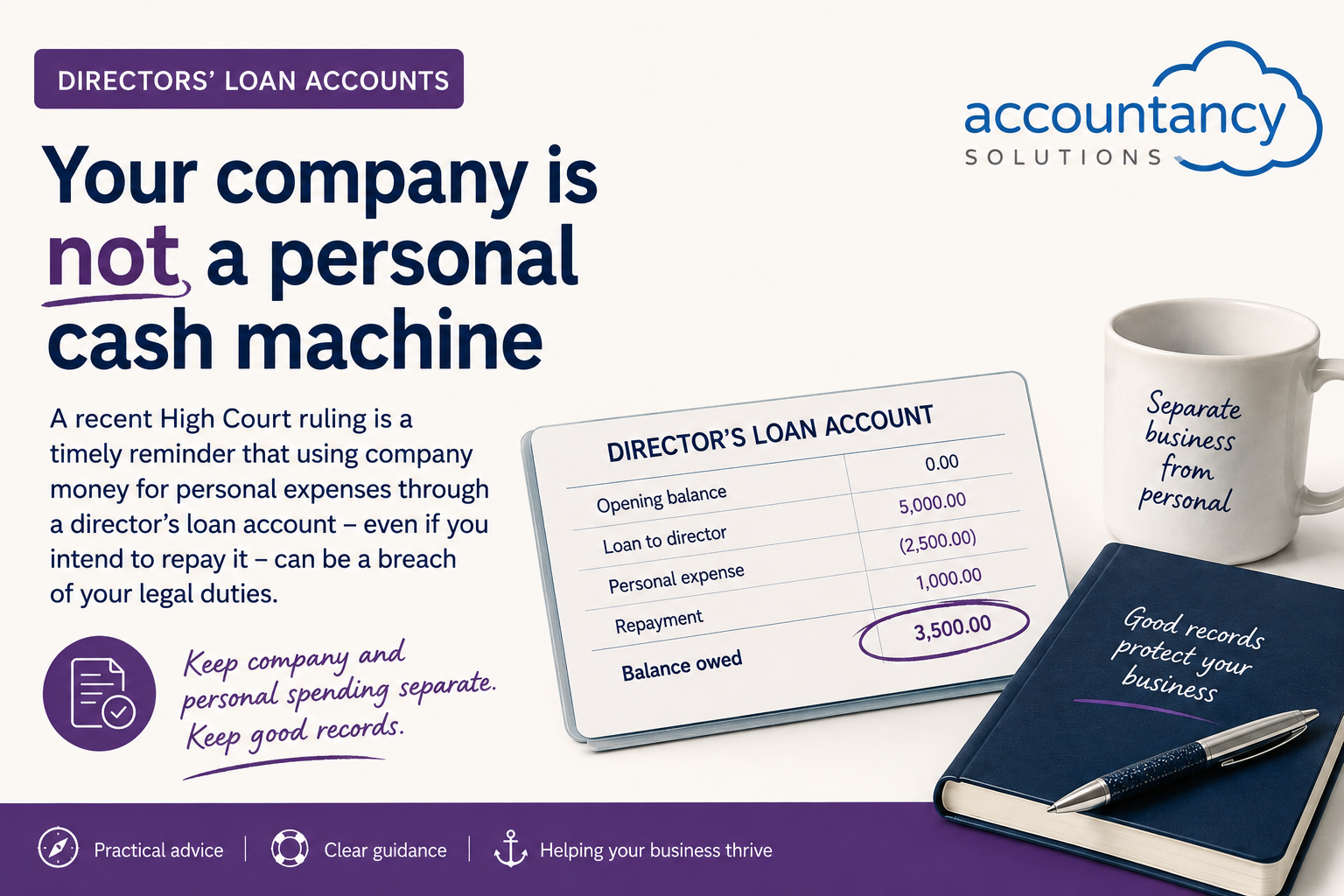
Keep company and personal spending separate. Keep good records. Make sure transactions are authorised where necessary. And don’t assume that repaying the money later automatically makes everything okay.
If you’re not sure what you can take from your company, ask before you transfer the money.
It is much easier to get it right at the beginning than to untangle a messy director’s loan account at the end of the year.
Useful links
If you’re looking for an accountant in Portchester, Fareham, Portsmouth, Hampshire or further afield, we’d love to have a chat about your business and how we could help.
Get in touch with Accountancy Solutions today to arrange a free, no-obligation consultation.
This article is intended as general information and not as legal or tax advice. The rules around directors’ loans can be complicated, particularly where a company is a close company, so speak to your accountant about your own circumstances.
Accountancy Solutions is an accountancy practice based in Portchester, Hampshire, providing bookkeeping, accounts, tax and business advisory services to small businesses across Portsmouth, Fareham, Gosport, Havant, Waterlooville and the surrounding area.
© Accountancy Solutions Ltd | Portchester, Hampshire