The answer is not simply “when you make money”. It depends on what you are doing, why you are doing it and how regularly you are doing it.
So, grab a slice of cake and let’s take a look.
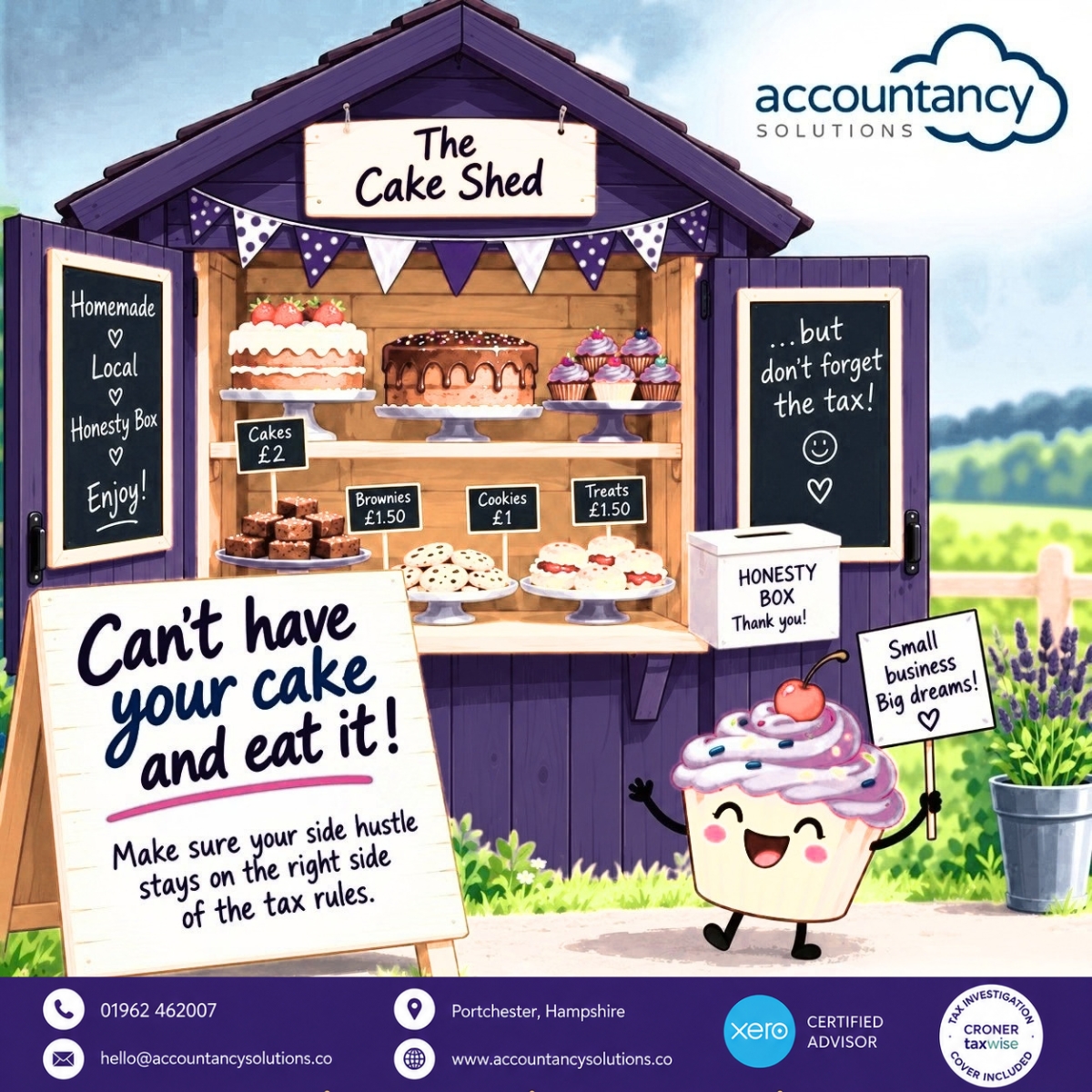
The cake shed side hustle
One of the latest side-hustle trends to hit the headlines is the humble cake shed.
The idea is simple. Bake cakes, brownies, biscuits or other treats, put them in a roadside cabinet and let customers pay via an honesty box or online payment.
It sounds wonderfully British.
It also sounds like a lovely way to turn a passion for baking into a bit of extra income.
But if you are regularly baking cakes specifically to sell to customers and making a profit, you may be running a business for tax purposes.
It doesn’t matter whether you have a shop, a website, a fancy till or a little wooden shed at the end of your driveway.
If you are carrying on a trade, the income may need to be declared to HMRC.
And that is where some side hustlers can get caught out.
“But it’s only a side hustle!”
This is one of the biggest misconceptions we come across.
Calling something a “side hustle” doesn’t give it a special tax-free status.
You can be:
- Employed Monday to Friday and run a business at weekends
- A student selling handmade products
- A parent selling cakes from home
- A pensioner selling items online
- A hobbyist making jewellery or crafts
- Someone buying and selling items for a profit
- Someone selling services alongside their main job
Your main employment doesn’t change the tax rules applying to your additional income.
The important question is whether what you are doing amounts to trading.
What about selling things on Vinted or eBay?
This is where things get particularly interesting.
Let’s say you have a wardrobe full of clothes you no longer wear and decide to sell them on Vinted.
You bought a dress for £80 a few years ago and sell it for £20.
That’s generally very different from buying ten dresses for £20 each because you think you can sell them for £40 each.
The first example looks like selling your own unwanted possessions.
The second starts to look much more like trading.
The same applies to eBay.
Clearing out the loft?
You sell your old toys, books, furniture and electrical items because you no longer need them.
That doesn’t automatically mean you have a taxable business.
Buying items to resell?
You spot bargains at car boot sales, charity shops or auctions, buy them with the intention of selling them on for more and do this regularly.
That is much more likely to be trading activity.
The distinction is important.
What about Etsy and handmade products?
If you make candles, jewellery, artwork, cards, clothing, cakes or other products and sell them regularly, you need to think carefully about whether you are carrying on a trade.
Again, it doesn’t matter whether you call it a hobby.
If you are making products specifically to sell and are doing so with the intention of making a profit, there may be tax consequences.
You don’t need to have a business premises.
You don’t need a company.
You don’t even necessarily need a business bank account.
You could be running a perfectly genuine business from your kitchen table.
The £1,000 trading allowance
There is, however, an important tax allowance that many side hustlers don’t know about.
The trading allowance can cover up to £1,000 of gross trading or miscellaneous income in a tax year.
And the word gross is important.
If you receive £1,200 from your side hustle and have £500 of expenses, you cannot simply say:
“I only made £700, so I’m under £1,000.”
Your gross income is £1,200.
There are also different rules around how the trading allowance interacts with expenses and Self Assessment, so if you are approaching or exceeding £1,000 of income, it is worth checking your position rather than assuming the allowance means you don’t need to do anything.
And what about VAT?
This is where things can get even more complicated.
VAT is completely separate from the £1,000 trading allowance.
A side hustle can have tax implications long before VAT registration becomes relevant.
But if your taxable turnover grows significantly, you also need to keep an eye on the VAT registration threshold.
And this is particularly important for businesses that start as “just a few orders”.
A cake business that starts with a couple of orders a week can grow surprisingly quickly.
Before you know it, that little cake shed could be doing some serious turnover.
HMRC has more information than you might think
Another reason not to assume that a side hustle is invisible is the amount of information now available to HMRC.
Online platforms can be required to collect and report information about sellers to HMRC under the digital platform reporting rules.
That doesn’t mean that everyone selling something online suddenly owes tax.
It does mean that you shouldn’t rely on the assumption that HMRC won’t know about your online selling activity.
The safest approach is to understand the rules and keep proper records.
So, when should you speak to an accountant?
If your side hustle is starting to become more than the occasional clear-out, it’s worth getting some advice.
Particularly if you are:
- Regularly selling products
- Buying things specifically to resell
- Making goods to sell
- Providing services for payment
- Taking regular payments through online platforms
- Making more than £1,000 of gross trading income
- Thinking about giving up your day job to work for yourself
- Approaching the VAT registration threshold
And don’t wait until January to start thinking about it.
Good bookkeeping makes everything much easier.
Keep records of your income and your business expenses from day one. Keep receipts. Keep invoices. Keep track of payments received.
You don’t need to make it complicated.
The important bit: don’t panic
Having a side hustle doesn’t automatically mean you are doing anything wrong.
Lots of people start businesses without realising that their hobby has crossed into trading territory.
The important thing is to understand where you stand and deal with it properly.
HMRC isn’t going to send the tax police round because you sold your old pair of jeans on Vinted.
But if you’re buying clothes specifically to resell, making hundreds of cakes a month or running a thriving Etsy shop from your spare room, it’s probably time to stop calling it “just a little side hustle” and start treating it like a business.
After all, you can have your cake and eat it.
You just need to remember to account for the tax on the slice you’re selling!
Thinking about starting a side hustle?
If your side hustle is starting to generate regular income, we’d be happy to have a chat about what you need to keep track of, what expenses you can claim and when you may need to tell HMRC.
Accountancy Solutions is a friendly, digital accountancy practice based in Portchester, Hampshire, helping small businesses and sole traders navigate their numbers without the jargon.
Get in touch with Hannah or the team for a chat about your side hustle.