The Government has confirmed that the overall annual ISA allowance will remain at £20,000, but for most people under the age of 65, the amount that can be paid into a Cash ISA will be reduced to £12,000 a year from 6 April 2027.
If you are aged 65 or over, the £20,000 Cash ISA allowance will remain available.
So, what does this mean for you?
What is changing?
Currently, you can save up to £20,000 each tax year into ISAs. You can choose how you use that allowance across Cash ISAs, Stocks and Shares ISAs and other types of ISA, subject to the relevant rules.
From 6 April 2027:
- The overall ISA allowance will remain at £20,000.
- If you are under 65, a maximum of £12,000 of this can be put into a Cash ISA.
- The remaining £8,000 can potentially be used for other types of ISA, such as a Stocks and Shares ISA.
- If you are aged 65 or over, you will continue to have a £20,000 Cash ISA allowance.
The £20,000 overall ISA allowance is currently planned to remain in place until 2030/31.
Why is this important?
Cash ISAs have traditionally been a popular choice for people who want to earn interest without paying tax on that interest.
The Government’s changes are designed, in part, to encourage more people to consider investing rather than holding all their savings in cash.
However, that doesn’t mean investing is right for everyone.
Cash savings and investments serve different purposes, and your decision will depend on your circumstances, your plans for the money and how comfortable you are with investment risk.
The important thing is to understand the changes and plan ahead rather than leaving it until April 2027.
There is still time to use the current £20,000 Cash ISA limit
The 2026/27 tax year runs from 6 April 2026 to 5 April 2027.
During this tax year, the existing rules continue to apply, meaning you can still use up to £20,000 of your annual ISA allowance for a Cash ISA, subject to the usual ISA rules.
For someone who normally saves a substantial amount into a Cash ISA, this could be worth considering as part of their financial planning.
For example, if you have £20,000 available to save and would normally put the whole amount into a Cash ISA, you may want to consider whether using some or all of your available allowance before 5 April 2027 fits your circumstances.
Don’t forget, though, that the ISA allowance is an annual allowance. You don’t need to put £20,000 into an ISA simply because you can.
What about money already in my Cash ISA?
The £12,000 limit is an annual subscription limit.
It does not mean that you will suddenly be limited to having £12,000 in your existing Cash ISAs.
Money that you have already built up in ISAs remains there.
The change affects how much new money you can put into a Cash ISA each tax year from April 2027.
This is an important distinction because the headlines can make it sound as though existing ISA savings are being capped.
What about Stocks and Shares ISAs?
The overall ISA allowance remains £20,000, so there will still be scope to use the remaining allowance for a Stocks and Shares ISA if that is appropriate for you.
However, there are some additional changes coming in 2027.
The Government has confirmed that interest earned on cash held within non-Cash ISAs, such as Stocks and Shares ISAs, will be subject to a flat 22% charge from April 2027. There are specific rules around Money Market Funds and other investments, so simply moving cash into a Stocks and Shares ISA should not be viewed as a way around the new Cash ISA limit.
There will also be restrictions on transferring money from a Stocks and Shares ISA or Innovative Finance ISA into a Cash ISA for people under 65 from April 2027.
How can you prepare?
There are a few things worth thinking about now.
1. Review your existing ISAs
Find out how much you currently have in Cash ISAs and what interest rate you are receiving.
Don’t assume that the rate you opened the account with is still competitive.
Some accounts offer attractive introductory rates that reduce after a set period.
2. Consider your 2026/27 ISA allowance
If you have money that you were already planning to put into a Cash ISA, consider whether you want to use more of your current allowance before 5 April 2027.
For under-65s, this is currently the final tax year in which the full £20,000 annual ISA allowance can be used for cash savings.
That doesn’t mean you should rush into a decision. Make sure you still have enough accessible cash for emergencies and your short-term plans.
3. Think about your savings goals
Ask yourself what the money is actually for.
If you are saving for something in the next year or two, keeping the money in cash may be appropriate.
If you are saving for a much longer-term goal, you may want to investigate whether investing could form part of your financial plan.
The two are not interchangeable. Investments can fall as well as rise, and you should understand the risks before investing.
4. Don’t forget your Personal Savings Allowance
If you have savings outside an ISA, remember that interest may be taxable.
Most people have a Personal Savings Allowance, currently £1,000 for basic-rate taxpayers and £500 for higher-rate taxpayers. Additional-rate taxpayers do not receive a Personal Savings Allowance.
This means the tax implications of moving money out of a Cash ISA need to be considered carefully.
5. Check whether your ISA is flexible
Some Cash ISAs are flexible, which can allow you to withdraw and replace money during the same tax year without using up additional ISA allowance.
Not all ISAs have this feature, so check the terms of your particular account.
6. Don’t leave it until the last minute
ISA providers are likely to be particularly busy as the 5 April 2027 deadline approaches.
If you decide to move money between ISAs, make sure you use the formal ISA transfer process rather than withdrawing the money yourself and paying it into another account.
Using the proper transfer process helps protect the tax-free status of your existing ISA savings.
The important thing to remember
The ISA changes don’t mean that Cash ISAs are disappearing.
They simply mean that, from April 2027, most people under 65 will have a lower annual limit for new Cash ISA subscriptions.
If you regularly save more than £12,000 a year in cash, now is a good time to start thinking about what the changes could mean for you.
You don’t necessarily need to do anything immediately. But reviewing your savings, understanding your tax allowances and considering your longer-term plans now gives you plenty of time to make an informed decision.
And remember, everyone’s circumstances are different. What makes sense for one person won’t necessarily make sense for another.
Please note: this is for general information only and is not financial advice. If you are unsure what the changes mean for your personal tax position, speak to a financial adviser about investments and savings, or your accountant about the tax implications.
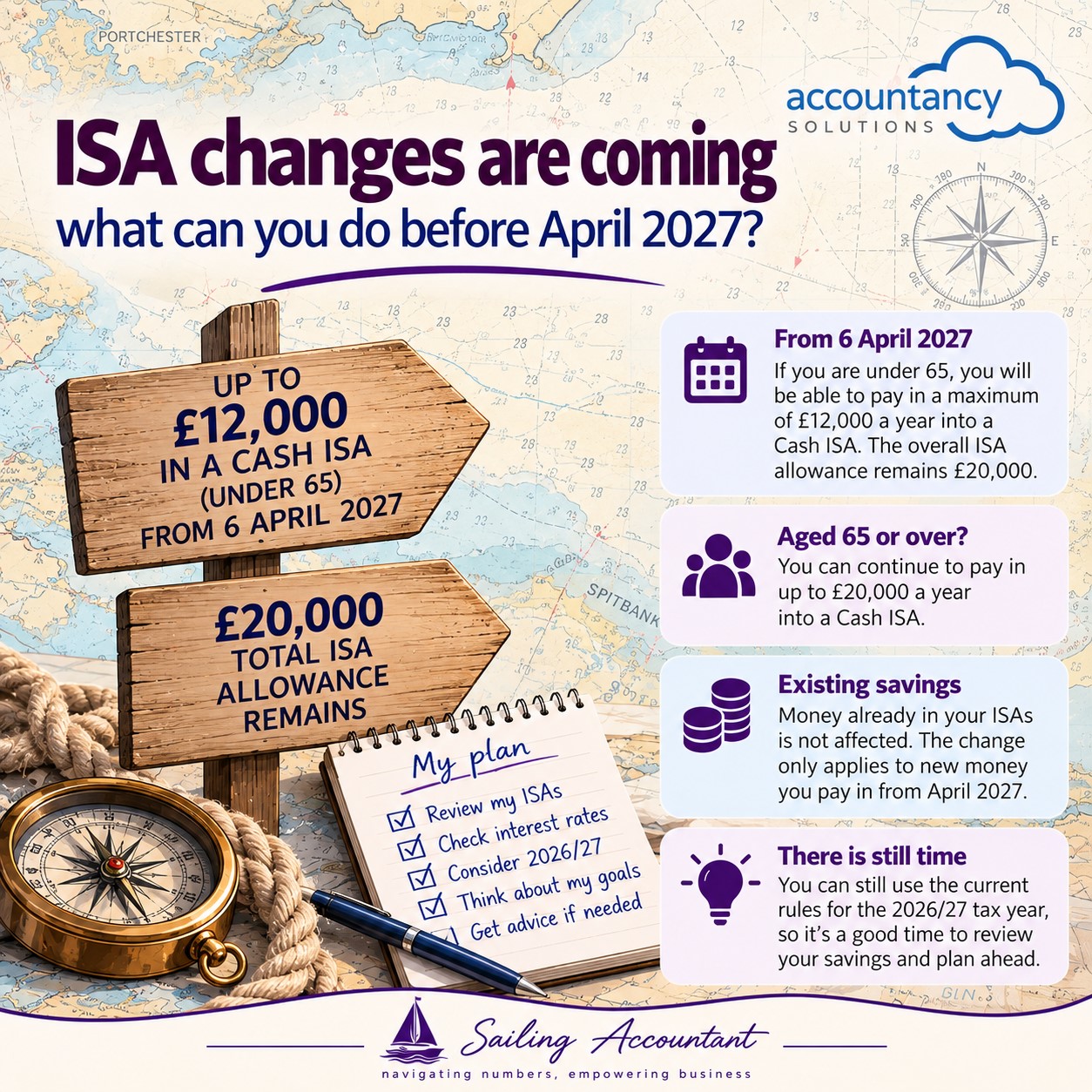
The Cash ISA limit for under-65s is changing from April 2027.
Useful links
- Bookkeeping services
- Training & Support
- Annual Statutory Accounts
- Sole Trader & Partnership Accounts
- All Accountancy Solutions services
- Invoice Checklist
- Contact Accountancy Solutions
Want to keep up with what’s happening at Accountancy Solutions?
We’ve started our mailing list to share our latest blog posts, useful accounting and tax updates, important deadlines and practical tips to help you stay on top of your business finances.
No endless sales emails and no complicated jargon. Just useful information, occasional updates from our team and things we think will genuinely help you and your business.
Sign up to our mailing list to get news and blog posts straight to your inbox.
Accountancy Solutions is an accountancy practice based in Portchester, Hampshire, providing bookkeeping, accounts, tax and business advisory services to small businesses across Portsmouth, Fareham, Gosport, Havant, Waterlooville and the surrounding area.
© Accountancy Solutions Ltd | Portchester, Hampshire