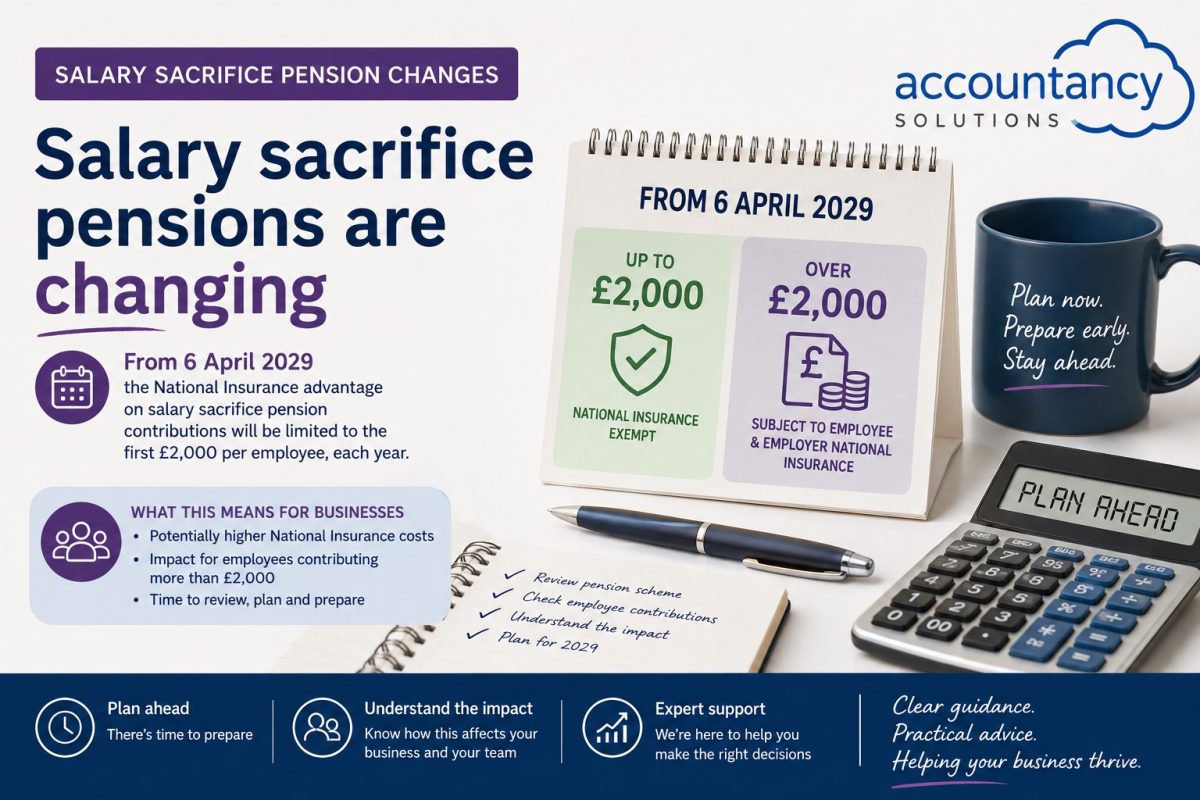
From 6 April 2029, the National Insurance saving available on pension contributions made through salary sacrifice will be limited to the first £2,000 per employee each year.
This doesn’t mean salary sacrifice is disappearing, and it doesn’t mean employees can only put £2,000 into their pension.
It means that, from 2029, the National Insurance rules will change for contributions above £2,000.
For businesses with employees making larger pension contributions, this could mean a higher National Insurance bill.
First, what is salary sacrifice?
Salary sacrifice is an arrangement where an employee agrees to give up part of their salary in return for their employer providing a benefit.
With pension salary sacrifice, instead of the employee receiving part of their salary and then making a pension contribution, their salary is reduced and the employer makes an additional pension contribution on their behalf.
For example, an employee earning £40,000 might agree to sacrifice £5,000 of their salary in return for a £5,000 employer pension contribution.
At present, this can be beneficial for both the employee and employer because the sacrificed amount is not subject to employee or employer National Insurance.
The employee still receives the benefit of pension tax relief, while both sides can potentially save National Insurance.
It has become an increasingly popular way of contributing to pensions.
So, what is changing?
From 6 April 2029, only the first £2,000 of pension contributions made through salary sacrifice each year will be exempt from National Insurance.
Any amount above £2,000 will still be able to go into the pension, and the pension contribution will still receive the normal Income Tax treatment.
However, the amount above £2,000 will be subject to National Insurance in the same way as other employee workplace pension contributions.
Importantly, both employee and employer National Insurance will apply to the amount above the £2,000 limit.
So, if an employee sacrifices £6,000 of salary into their pension, the first £2,000 will continue to benefit from the National Insurance exemption.
The remaining £4,000 will be subject to the relevant National Insurance charges.
Does this mean employees can only pay £2,000 into their pension?
No.
This is an important distinction.
The £2,000 figure is not a limit on pension contributions.
An employee can still contribute more than £2,000 through salary sacrifice if they want to.
The change is about how much of that contribution can be made without paying National Insurance.
The Income Tax treatment of pension contributions is not being removed by this measure.
So someone who wants to contribute £10,000 a year to their pension will still be able to do so.
The difference is that the National Insurance saving will only apply to the first £2,000 if they use salary sacrifice.
Who will actually be affected?
This is where things become more interesting.
The Government estimates that around 7.7 million employees currently use salary sacrifice to make pension contributions.
Of those, around 3.3 million contribute more than £2,000 through salary sacrifice and will therefore be affected by the change. Around 4.3 million people currently using salary sacrifice are expected to remain fully protected by the £2,000 threshold.
So if your employees are making relatively modest pension contributions, you may see little or no difference.
For example, an employee sacrificing £150 a month is contributing £1,800 a year. They would remain below the £2,000 threshold.
An employee sacrificing £500 a month is contributing £6,000 a year. They would have £4,000 of contributions above the threshold which will be subject to National Insurance.
The impact will therefore vary considerably from business to business.
And it isn’t just the employee who is affected
This is the part employers need to pay particular attention to.
At present, salary sacrifice can reduce the employer’s National Insurance bill as well as the employee’s.
From 2029, employers will have to pay employer National Insurance on pension salary sacrifice above the £2,000 annual threshold.
That means a business with several employees making substantial pension contributions could see its payroll costs increase.
The Government estimates that around 290,000 employers operate pension salary sacrifice arrangements and will need to make changes to their payroll processes where employees contribute more than £2,000 through salary sacrifice.
What could this mean for your business?
Let’s take a simple example.
Imagine you have an employee who sacrifices £8,000 of salary into their pension each year.
Under the new rules, the first £2,000 remains within the National Insurance-free salary sacrifice arrangement.
The remaining £6,000 will be subject to employee and employer National Insurance.
That means:
Employee: potentially pays more National Insurance.
Employer: potentially pays more employer National Insurance.
Pension contribution: can still be £8,000.
Income Tax treatment: the pension contribution continues to receive the normal pension tax treatment.
The actual cost will depend on the employee’s circumstances, their earnings and the National Insurance rates applying at the time.
Should you stop offering salary sacrifice?
Not necessarily.
For many employees, salary sacrifice will continue to be worthwhile.
The Government has deliberately set the threshold at £2,000, meaning employees making typical contributions can continue to benefit from the arrangement.
The Government estimates that 56% of employees currently making pension contributions through salary sacrifice will be unaffected by the change.
For employers, however, it is worth looking at your current arrangements rather than simply assuming that nothing needs to change.
If you have a small workforce and relatively low pension contributions, the financial impact may be negligible.
If you have employees making substantial pension contributions, particularly higher-paid employees, the additional employer National Insurance could become significant.
Don’t forget the payroll implications
There is also a practical issue here.
Payroll systems and pension arrangements will need to distinguish between the first £2,000 of salary-sacrificed pension contributions and anything above it.
The Government has said employers will need to report the total amount sacrificed through their existing payroll software, with further guidance to be published before the changes take effect.
So this isn’t something to leave until the first payroll of April 2029.
There will be plenty of time to prepare, but employers should eventually check:
- How their salary sacrifice scheme is currently set up
- Which employees are making contributions above £2,000
- The likely additional employer National Insurance cost
- How their payroll software will deal with the new rules
- Whether their employment contracts or salary sacrifice agreements need updating
- Whether their pension provider needs any information from them
What about employees who don’t use salary sacrifice?
The change only affects the National Insurance treatment of pension contributions made through salary sacrifice.
It does not remove the normal tax relief available on pension contributions.
So if an employee makes pension contributions through another arrangement, the new £2,000 salary sacrifice limit does not automatically apply to those contributions.
This is why it is important not to look at the headline and assume that pension tax relief is being removed.
It isn’t.
The Government is changing the National Insurance advantage associated with salary sacrifice.
What should employers do now?
There is no need to panic.
The changes do not come into effect until April 2029, and further guidance is expected before then.
But this is a good opportunity to start looking at your payroll and pension arrangements.
If you have employees making significant pension contributions through salary sacrifice, work out what the additional employer National Insurance cost could look like.
It may also be worth considering whether your current pension and salary sacrifice arrangements remain the best fit for your business and your employees.
And don’t forget that salary sacrifice is just one part of your overall payroll costs. Changes to National Insurance, minimum wage rates, pension contributions and other employment costs can all add up.
We can help you understand the numbers
Tax changes can be difficult to interpret from a headline, particularly when they are announced several years before they actually take effect.
At Accountancy Solutions, we can help you understand what changes such as this could mean for your business rather than simply telling you that the rules have changed.
Our payroll services can take care of your regular payroll processing and help make sure your employees are paid correctly and the necessary information is reported to HMRC.
We can also help with management accounts and budgeting, so you can see how changes to employment costs could affect your business before they hit your bottom line.
If you’re reviewing your staffing costs or considering changes to employee benefits, it is worth having the numbers in front of you before making decisions.
The bottom line
Salary sacrifice for pensions isn’t going away.
But from 6 April 2029, the National Insurance advantage will be capped at £2,000 per employee per year.
For employees making smaller pension contributions, there may be little or no impact.
For employees making larger contributions, both they and their employers could pay more National Insurance on the amount above £2,000.
There is plenty of time to prepare, but businesses with salary sacrifice schemes should have this on their radar now.
If you have employees using salary sacrifice, don’t wait until 2029 to find out what it could cost you.
Useful links
- GOV.UK: Changes to salary sacrifice for pensions from April 2029
- GOV.UK: Salary sacrifice reform for pension contributions
- GOV.UK: Budget 2025
- Our payroll services
- Our management accounts service
- Contact Accountancy Solutions
This article is intended as general information and reflects the rules and guidance available at the time of writing. The salary sacrifice pension changes are due to take effect from April 2029 and further guidance is expected. If you are considering changing your pension or salary sacrifice arrangements, speak to your accountant or payroll adviser about your particular circumstances.