What is a Self Assessment tax return?
A Self Assessment tax return is how you tell HMRC about your income, expenses and other relevant financial information for the tax year.
The tax year runs from 6 April to 5 April the following year.
You may need to complete a tax return if you:
- Are self-employed and your gross trading income exceeds £1,000.
- Receive rental income.
- Have significant savings or investment income that isn’t taxed at source.
- Receive dividends above the relevant tax-free allowance.
- Have capital gains to report.
- Have other income that HMRC needs to assess.
- Have been asked by HMRC to complete a return.
Your tax return brings together your different sources of income, allowable expenses, tax reliefs and any tax already paid. HMRC then calculates how much tax you owe.
What are the important Self Assessment deadlines?
There are several dates to remember.
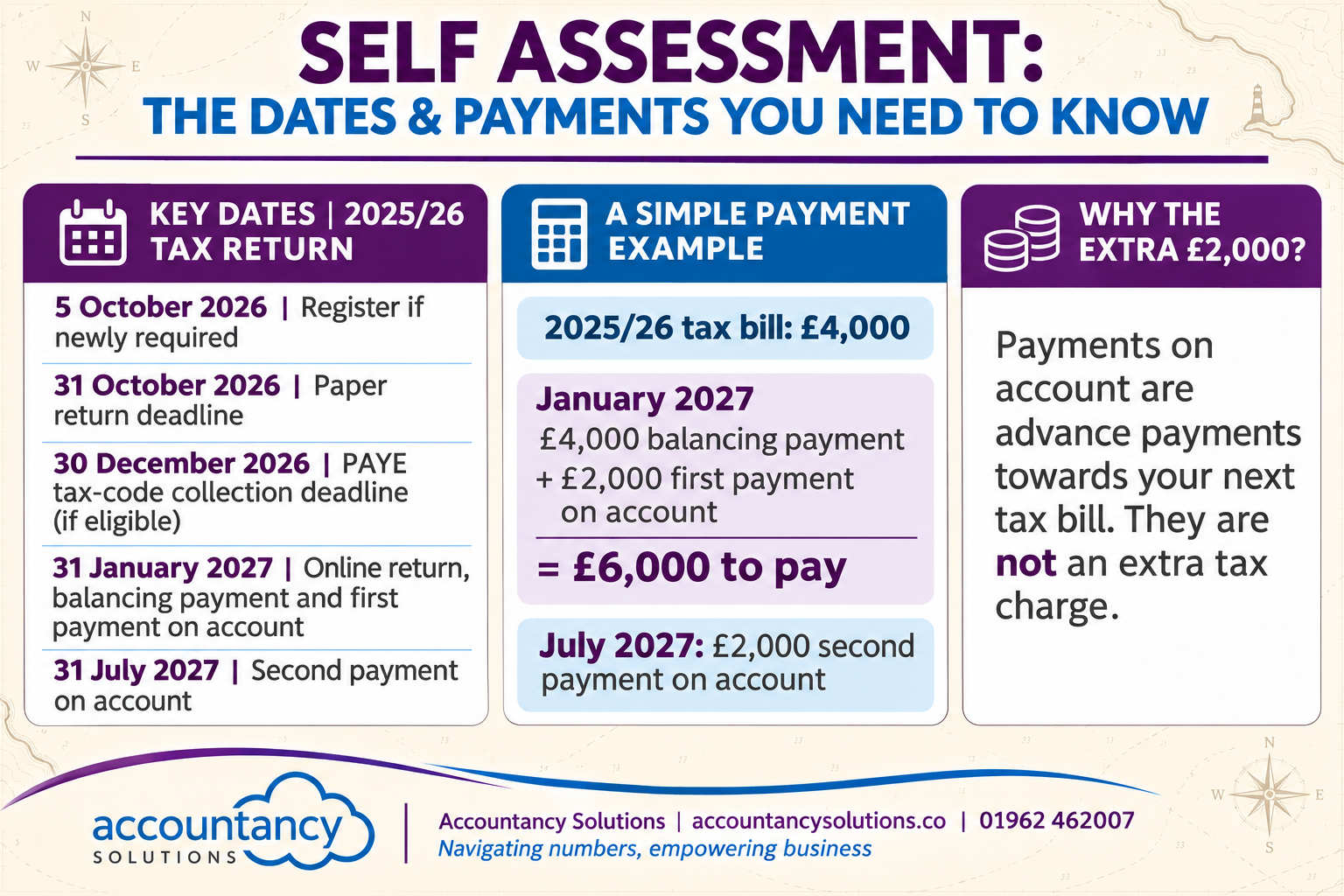
| Deadline | What needs to happen? |
|---|---|
| 5 October 2026 | Register for Self Assessment for the 2025/26 tax year if you’re newly required to file |
| 31 October 2026 | Deadline for submitting a paper tax return |
| 30 December 2026 | Deadline for online submission if you want eligible tax collected through your PAYE tax code |
| 31 January 2027 | Deadline for submitting your online tax return and paying any balancing payment for 2025/26 |
| 31 January 2027 | First payment on account towards your 2026/27 tax bill, if applicable |
| 31 July 2027 | Second payment on account towards your 2026/27 tax bill |
It’s worth remembering that you don’t have to wait until January to submit your tax return. You can submit it as soon as the tax year has ended and the necessary information is available.
In fact, submitting early is a good idea. You’ll know what you owe, have more time to budget and avoid the last-minute rush.
What is a balancing payment?
A balancing payment is the difference between the tax you owe for a tax year and the tax you’ve already paid towards it.
For example, imagine you’re self-employed and your final tax calculation for 2025/26 shows that you owe £4,000.
If you haven’t made any payments on account or paid tax through PAYE towards that liability, the full £4,000 will be due by 31 January 2027.
However, if you’ve already paid £2,000 towards that tax bill, your balancing payment will only be £2,000.
The important thing is that HMRC wants the outstanding balance paid by the January deadline.
What are payments on account?
This is where things can become a little confusing!
Payments on account are advance payments towards your next tax year’s bill.
HMRC uses your previous year’s tax liability to estimate what you might owe for the following year. Rather than waiting until the end of that year, it asks you to pay in two instalments.
Each payment is normally 50% of the relevant tax and National Insurance liability from the previous year.
The payments are due on:
- 31 January
- 31 July
You normally have to make payments on account if your relevant Self Assessment tax liability is at least £1,000 and 80% or less of your tax was collected outside Self Assessment, for example through PAYE.
Payments on account generally cover Income Tax and Class 4 National Insurance where applicable. They do not normally include Capital Gains Tax or student loan repayments.
A worked example: How payments on account work
Let’s look at a simple example.
Imagine your tax bill for 2025/26 is £4,000.
You haven’t made any payments on account during the year, so the full £4,000 is due as your balancing payment.
HMRC will also ask you to make payments towards your 2026/27 tax bill, based on the £4,000 liability.
Each payment on account will be £2,000.
This means your January payment will include both your outstanding tax and your first advance payment.
Here’s how it looks:
| Payment | Amount |
|---|---|
| Balancing payment for 2025/26 | £4,000 |
| First payment on account for 2026/27 | £2,000 |
| Total due by 31 January 2027 | £6,000 |
| Second payment on account by 31 July 2027 | £2,000 |
So, although your actual tax bill for 2025/26 is £4,000, you need to find £6,000 in January.
The additional £2,000 isn’t an extra tax charge. It’s an advance payment towards your next tax bill.
When you complete your 2026/27 tax return, the payments on account you’ve made will be deducted from the final amount due.
What happens if your tax bill goes up or down?
Payments on account are based on your previous year’s tax liability, not a guarantee of what you’ll owe next year.
If your profits increase, you could end up with an additional balancing payment when your next tax return is calculated.
If your profits decrease, you may have overpaid and could be entitled to a refund or have less to pay.
You can ask HMRC to reduce your payments on account if you genuinely expect your next tax bill to be lower.
However, be careful. If you reduce them too much and your actual tax liability is higher than expected, HMRC can charge interest on the underpaid amount.
It’s always worth reviewing your expected profits and tax position before making a reduction.
How can you avoid a nasty surprise in January?
The best approach is to plan ahead.
Here are a few simple steps:
- Keep your records up to date. Make sure your income and expenses are recorded throughout the year.
- Put money aside for tax. Don’t treat all the money you take as dividend or as drawings as yours to spend
- Submit your return early. Knowing your tax liability gives you time to plan.
- Understand payments on account. Remember that your January bill may include both a balancing payment and an advance payment.
- Review your profits. If your income has changed significantly, check whether your payments on account are still appropriate.
You can also arrange regular weekly or monthly payments through an HMRC Budget Payment Plan, helping you spread the cost rather than finding a large sum in January.
How can Accountancy Solutions help?
Self Assessment doesn’t need to be stressful. We can help you understand what information is needed, prepare and submit your return, calculate your tax liability and explain when payments are due.
Whether you’re self-employed, a landlord or have additional income to declare, we can help make sure everything is submitted correctly and on time.
Don’t leave it until January!
Get in touch with Accountancy Solutions to discuss your Self Assessment return.
Visit accountancysolutions.co or call 01962 462007.