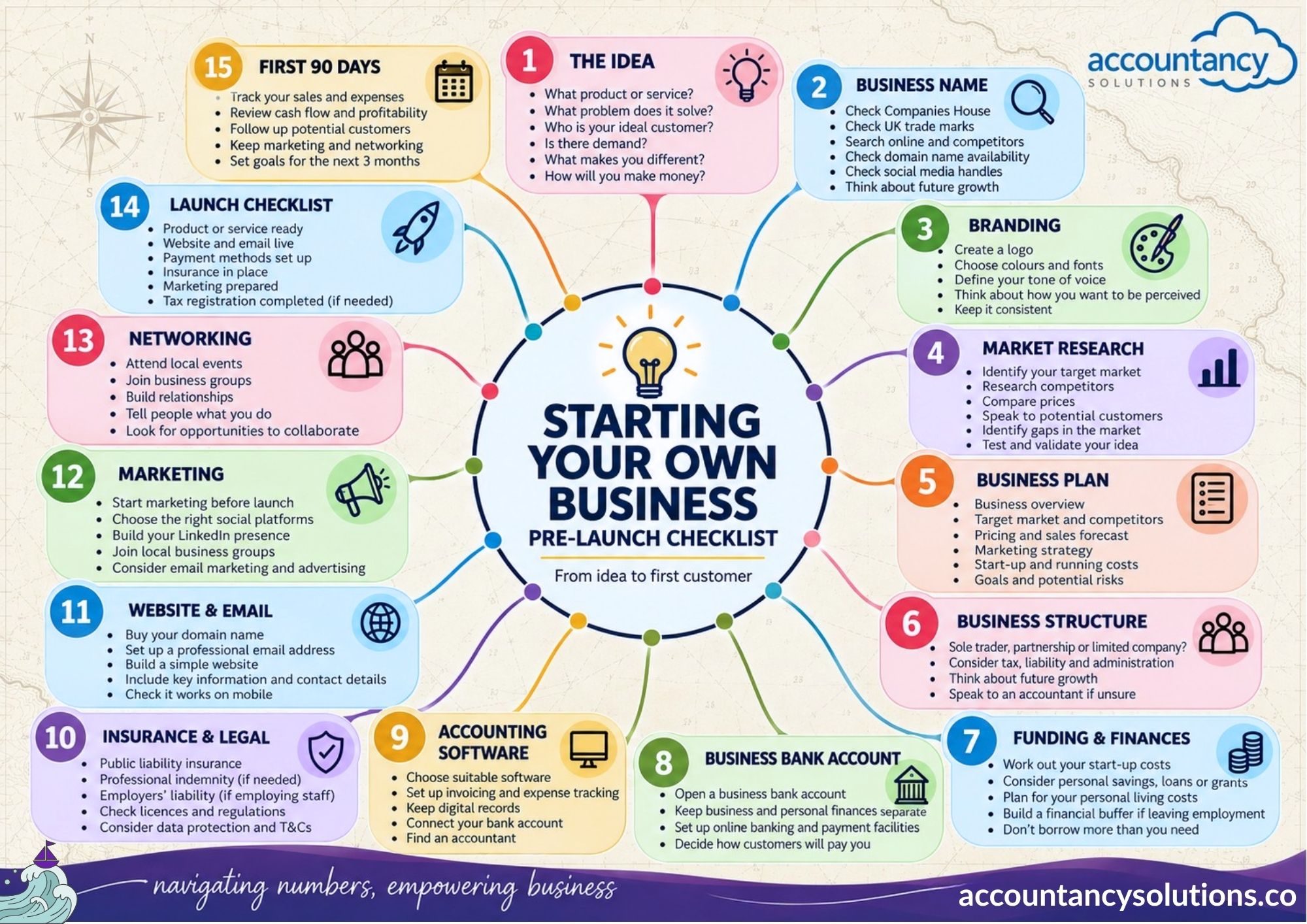
At Accountancy Solutions, we work with businesses at all stages, including people taking their very first steps into self-employment. So, here is our practical guide to the things we think you should consider before launching your business.
1. Start with the idea, not the logo
It is very tempting to jump straight into choosing colours, designing a logo and setting up an Instagram account.
Before you do that, take a step back.
Ask yourself:
- What am I actually selling?
- Who is going to buy it?
- What problem does it solve?
- Why would someone choose me rather than an existing business?
- How much will people pay for it?
- How much will it cost me to provide?
- Is there actually a market for it?
If you are selling a product, look at similar products, competitors, prices, customer reviews and demand.
If you are providing a service, look at what other businesses charge and what they include.
Do some proper market research. Speak to potential customers. Ask questions. Look at your competitors.
You do not want to spend thousands creating something nobody actually wants.
The government’s Business.gov.uk guidance recommends testing and validating your business idea before committing fully to it.
2. Choose your business name carefully
Your business name might feel like a small decision, but changing it later can be expensive and disruptive.
Before you fall in love with a name, do your homework.
Check:
- Companies House
- The UK trade mark database
- Available website domains
- TikTok and other platforms relevant to your business
- Similar names used by competitors
And don’t just look for an identical name.
A name that is very similar to an existing business or trade mark could still cause problems.
Government guidance specifically recommends checking Companies House, trade marks, domains and social media handles before committing to a name.
If your brand is going to be an important part of your business, you may also want to consider registering a trade mark. A registered trade mark can provide legal protection for your brand.
Our advice? Do the checks before you spend money on signs, uniforms, packaging, websites and printed stationery.
3. Think about your branding
Once you are happy with the name, think about how you want the business to look and feel.
You don’t need to spend thousands on branding at the start.
You do need consistency.
Think about:
- Your logo
- Colours
- Fonts
- Photography or imagery
- Tone of voice
- How you want customers to perceive you
- What makes you different
Your branding should reflect the type of customers you want to attract.
A professional brand doesn’t necessarily mean an expensive brand.
4. Write a business plan
Don’t skip this because you think business plans are only for banks.
A business plan forces you to think through how the business is actually going to work.
It should cover things such as:
- What your business does
- Your target customers
- Your competitors
- Your pricing
- Your marketing strategy
- Your expected sales
- Your costs
- Your cash flow
- How much money you need to start
- How you will fund the business
- Your short and long-term goals
- Potential risks
A business plan is also extremely useful if you need funding.
Business.gov.uk recommends including your objectives, customers, competitors, pricing, sales forecasts, marketing strategy, operating requirements and risks.
5. Work out how much money you need
This is one of the areas where new business owners often underestimate what they need.
Make a list of your start-up costs.
For example:
- Equipment
- Stock
- Website
- Branding
- Software
- Insurance
- Accountancy
- Professional fees
- Marketing
- Advertising
- Premises
- Vehicles
- Packaging
- Training
- Licences
- Bank charges
Then think about your ongoing monthly costs.
And don’t forget yourself.
If you are leaving paid employment to start your business, how are you going to pay your mortgage or rent, household bills and other personal expenses while the business gets established?
Ideally, build up a personal financial buffer before you leave your job.
It is much easier to make good business decisions when you are not desperately waiting for your first customer to pay an invoice.
6. Decide how you are going to fund the business
There are several ways to fund a start-up.
You might use:
- Personal savings
- Money from family or friends
- A business loan
- A government-backed Start Up Loan
- Grants
- Investment
- Pre-orders or deposits from customers
The government-backed Start Up Loan currently allows eligible applicants to borrow between £500 and £25,000, with fixed interest and access to support and mentoring.
Don’t borrow money simply because it is available.
Work out how much you actually need and how you will repay it.
7. Decide on your business structure
One of the biggest decisions you need to make is how your business will be structured.
The most common options for a new small business are:
Sole trader
This is often the simplest structure for an individual starting a business.
You are personally responsible for the business and its debts, and you pay tax on your business profits through Self Assessment.
You can start trading as a sole trader without formally registering first, but you generally need to register for Self Assessment if your trading income is more than £1,000 in a tax year.
Limited company
A limited company is legally separate from its owners.
There are more administration and filing responsibilities, but there can be advantages depending on your circumstances.
If you set up a limited company, you need to register it with Companies House before it starts trading.
Click here to find out how we can help
Partnership
If you are going into business with another person, a partnership may be appropriate.
In a traditional partnership, the partners share responsibility for the business, including its losses, and each partner pays tax on their share of the profits.
There are also other structures, including LLPs and limited companies with multiple owners.
Don’t automatically choose a limited company because you think it sounds more professional.
The right structure depends on your circumstances, income, plans and the type of business you are running.
This is one of the areas where speaking to an accountant before you start can be very worthwhile.
8. Set up your business bank account
Keep your business and personal finances separate from the beginning.
Even if you are a sole trader and a separate business account is not legally required, it can make your bookkeeping considerably easier.
It means you can see what belongs to the business, track your income and expenses and keep much better records.
Limited companies must keep company finances separate from the finances of their owners.
Business.gov.uk also recommends separating business and personal finances to make accounting and tax reporting easier.
9. Choose your accounting software
You don’t want to reach the end of your first year and discover that you have a carrier bag full of receipts and no idea how much money you’ve actually made.
Choose suitable accounting software from the start.
Depending on your business, this could help you:
- Raise invoices
- Record expenses
- Track income
- Reconcile your bank account
- Keep digital records
- Monitor cash flow
- Prepare information for your accountant
- Keep an eye on profitability
Your accountant can help you choose software that is appropriate for your business rather than simply choosing whatever your friend happens to use.
Find out more about software – here
10. Don’t forget insurance
The insurance you need depends on what your business does.
You may need cover such as:
- Public liability insurance
- Professional indemnity insurance
- Product liability insurance
- Employers’ liability insurance
- Business contents insurance
- Vehicle insurance
- Cyber insurance
If you employ people, Employers’ Liability insurance is generally a legal requirement.
You should also check whether your business needs any specific licences, permissions or industry-specific insurance. Business.gov.uk recommends checking insurance, licences and regulations as part of getting ready to operate.
11. Build your website and professional email address
Your website doesn’t need to be enormous.
For many start-ups, a simple website covering:
- Who you are
- What you do
- Who you help
- Your products or services
- Prices or starting prices where appropriate
- How to contact you
- Frequently asked questions
- Testimonials once you have them
is enough to begin with.
And don’t forget your email address.
A professional email address using your own domain generally looks much more credible than a personal Gmail or Hotmail address.
For example:
rather than:
12. Start marketing before you launch
Don’t wait until launch day to tell people you exist.
Start building awareness beforehand.
Depending on your target audience, consider:
- TikTok
- Local Facebook groups
- Email marketing
- Networking
- Local business groups
- Google Business Profile
- Paid advertising
- Partnerships with complementary businesses
- Local press
You don’t need to be everywhere.
Choose the platforms where your potential customers actually spend their time.
13. Build your LinkedIn presence
If you are running a business-to-business operation, LinkedIn can be particularly valuable.
Don’t just create a company page and leave it empty.
Your personal profile matters too.
Tell people:
- What you do
- Who you help
- Why you started
- What you know
- What problems you solve
- What is happening in your business
People buy from people.
Especially when they are buying professional services.
14. Get out and network
Networking can be one of the cheapest ways to build a new business.
Go to local events.
Join business groups.
Meet other business owners.
Tell people what you do.
And, importantly, don’t make every conversation about selling.
Build relationships.
The person you meet today may not need you, but they might know someone who does.
15. Find an accountant before you need one
You don’t have to wait until your first tax return is due to find an accountant.
Getting advice early can help you make better decisions from the beginning.
An accountant can help you think about:
- Sole trader versus limited company
- Tax
- VAT
- Accounting software
- Bookkeeping
- Business expenses
- Cash flow
- Payroll
- Business structure
- Financial forecasts
- Tax planning
For example, the current VAT registration threshold is £90,000 of taxable turnover, although there are circumstances where other VAT rules can apply.
Knowing these things before you get close to a threshold can be much easier than trying to sort everything out afterwards.
16. Think about tax from day one
One of the biggest mistakes new business owners make is spending all the money in their bank account because they think it is all theirs.
It isn’t.
Part of it may belong to HMRC.
Start putting money aside for tax from the beginning.
Keep good records.
Know when your tax payments are due.
And don’t forget that your tax position can change as your business grows.
17. Launch before everything is perfect
There comes a point when planning becomes procrastination.
You don’t need:
- The perfect website
- 10,000 followers
- A huge office
- A massive product range
- A perfect logo
- Every possible software package
You need a viable product or service, customers who want it and a way of delivering it profitably.
Start small.
Learn.
Listen to your customers.
Improve.
Then grow.
18. Keep reviewing the numbers
Once you launch, don’t forget about the financial side of the business.
Look at your numbers regularly.
Ask yourself:
- How much have I sold?
- How much profit am I making?
- Which products or services are most profitable?
- Who owes me money?
- What bills are coming up?
- How much cash do I have?
- How much tax do I need to set aside?
- Am I charging enough?
- Am I actually paying myself enough?
Your accounts shouldn’t just tell you what happened last year.
They should help you decide what to do next.
A final word before you take the leap
Starting a business can be one of the most rewarding things you ever do.
It can also be challenging, particularly when you are trying to do everything yourself.
You don’t have to know everything.
You don’t have to do everything yourself.
Build a good support network around you, get professional advice where you need it and make sure you understand the numbers before you take the leap.
And if you’re thinking about starting your own business, we’d be happy to have a chat.
At Accountancy Solutions, we work with small businesses and start-ups and can help you get the financial side of your new business set up properly from the beginning.
A useful free course for new business owners
If you are at the very beginning of your journey, it may also be worth looking at the Level 2 Creating a Business Start-Up course from The AIM Group.
At the time of writing, their website states that the course can be available free to eligible learners, subject to location and eligibility requirements. It covers business planning, marketing, legal and financial considerations and the initial steps involved in creating a business.
Always check the current eligibility requirements and availability before enrolling.
Useful official resources
For further information, the government-backed Business.gov.uk guide covers planning, testing your idea, naming your business, business structures, funding, banking, accounting, insurance and regulations.
You can also find detailed guidance on setting up a business on GOV.UK.